

Code you can read.Speed you can measure.Binaries you can ship.
tiko is a compiled, statically typed language for building fast, self-contained programs. Readable syntax on top; generics, channels, typed errors and direct C-header import underneath, compiled through LLVM with no garbage collector and no runtime to install.
Other platforms · Release notes · pre-1.0, free and open source
#import "std/containers"
#import "std/strings"

'' Count the words in a sentence and return the most common one.
function MostCommon( byval text as ustring ) as (word as ustring, count as int32)
    dim counts as containers.Map( of ustring, int32 )
    for each w as ustring in strings.Split( LCase( text ), " " )
        counts[ w ] += 1
    next

    dim as ustring best
    dim as int32 most = 0
    for each e in counts
        if e.Value > most then best = e.Key : most = e.Value
    next
    return (best, most)
end function

var (word, n) = MostCommon( "the quick brown fox jumps over the lazy dog the end" )
print "'" & word & "' appears " & n & " times"
'the' appears 3 times
defer, shared pointersThe readable systems language
For tools, services, command-line programs and native apps, when you want Python's clarity and C's executables.
Readable by design
Every block says what it closes: end function, next, end if. A reviewer never counts braces.
C-class speed
Its own front end and typed IR, then LLVM. Measured against C, Rust, Go and Zig, scripts in the repo.
Tiny, self-contained
One small executable, no runtime to install, no Visual Studio needed for the Windows target.
Concurrency built in
spawn a procedure, pass values through typed channels, wait on several with select channel.
Reads C headers directly
#cinclude "sqlite3.h" imports a C library's own header. You don't write a binding.
Batteries included
Containers, Result/Optional, filesystem, time zones, HTTP and TLS, exact decimals, logging and a TUI toolkit.
Modern features, plain words
Every sample here compiles and runs with the current toolchain.
#import "std/fs"

var r = fs.ReadAllText( "settings.ini" )
if r.IsOk( ) then
    print len( r.Value( ) ); " characters"
else
    print "cannot read settings.ini: "; r.Failure( ).Message( )
end if
cannot read settings.ini: no such file or directory
#import "std/fs"

function SaveReport( byval path as ustring, byval total as int32 ) as boolean
    dim as fs.File f
    var r = f.Open( path, fs.OpenOptionsWrite( ) )
    if not r.IsOk( ) then
        print "cannot open "; path; ": "; r.Failure( ).Message( )
        return false
    end if
    defer print "file closed: "; f.Close( ).IsOk( )    '' runs on every way out

    f.WriteUtf8( "Monthly report" & chr( 10 ) )
    if total < 0 then
        print "error: total is negative"
        return false                      '' early exit: the file still closes
    end if
    f.WriteUtf8( "Total: " & total & chr( 10 ) )
    return true
end function

var ok = SaveReport( "report.txt", -5 )
print "saved: "; ok
error: total is negative file closed: true saved: false
#import "std/tasks"

sub Squares( byval sink as tasks.SendChan( of int32 ), byval n as int32 )
    for i as int32 = 1 to n
        sink.Send( i * i )
    next
    sink.Close( )
end sub

dim results as tasks.Channel( of int32 ) = tasks.Channel( of int32 )( 8 )
spawn Squares( results, 5 )

dim as int32 total = 0
for each v in results
    total += v
next
print "sum of squares:"; total
sum of squares: 55
#import "std/containers"

type Point
    x as float64
    y as float64
end type

dim pts as containers.Array( of Point )
pts.Push( type( 3, 4 ) ) : pts.Push( type( 1, 1 ) ) : pts.Push( type( 0, 2 ) )

containers.SortBy( pts, function( byref a as const Point, byref b as const Point ) as boolean
    return a.x * a.x + a.y * a.y < b.x * b.x + b.y * b.y
end function )

for each p in pts
    print p.x; ","; p.y
next
1, 1 0, 2 3, 4
#cinclude once "math.h"

print "cube root of 27 ="; cbrt( 27.0 )
cube root of 27 = 3
Get tiko
One archive per system. Unpack it anywhere: tiko finds its own headers and libraries, and needs no environment variables. Each archive also carries tkEdit, a GUI-based, multi-buffer editor.
Windows
Windows 10 or 11, x86-64. Also builds Android apps tiko-windows-x86_64-01c1f625.zip f515f8421633c1a6105a8335c79b52b55800b735c7dc427611fc5a20453f7f7b Download .zipLinux x86-64
x86-64 (amd64), glibc tiko-linux-x86_64-01c1f625.tar.gz 478bf2f21e054172a6f153b090e48a2c0252cea6e22e015442a922aa67b1854c Download .tar.gzLinux arm64
aarch64, glibc 2.35+: Ubuntu 22.04+, Debian 12, Raspberry Pi OS 64-bit tiko-linux-arm64-01c1f625.tar.gz a25f6ded601a5a07a142a7441bbf290bdaafb9dcee2aa2065ada034ec970fcf5 Download .tar.gzmacOS
Apple Silicon (arm64), macOS 13+ tiko-macos-arm64-01c1f625.tar.gz 37a515a0811144666b22d8b755faa76b81cdb86f5fb9b62f3bc93ed1906f82ac Use curl: see stepsDownload and unzip
Download tiko-windows-x86_64-01c1f625.zip and unzip it anywhere. You get one folder,
tiko-lang\. Or, in PowerShell:curl.exe -fLO https://github.com/PaulSquires/tiko-lang/releases/download/toolchain-01c1f625/tiko-windows-x86_64-01c1f625.zip tar -xf tiko-windows-x86_64-01c1f625.zipInstall clang 18 or newer
tiko uses clang to compile and link. It is not bundled.
winget install LLVM.LLVMCompile your first program
Save
print "Hello, world!"ashello.tiko, then:tiko-lang\tiko.exe hello.tiko -o hello.exe hello.exeOpen the editor with
tiko-lang\tkedit.exe.
Download and unpack
Not sure which?
uname -mprintsx86_64oraarch64. x86-64 (most PCs and servers):curl -fLO https://github.com/PaulSquires/tiko-lang/releases/download/toolchain-01c1f625/tiko-linux-x86_64-01c1f625.tar.gz tar -xzf tiko-linux-x86_64-01c1f625.tar.gzarm64 / aarch64 (Raspberry Pi 4 and 5, Arm servers and VMs; glibc 2.35 or newer):
curl -fLO https://github.com/PaulSquires/tiko-lang/releases/download/toolchain-01c1f625/tiko-linux-arm64-01c1f625.tar.gz
tar -xzf tiko-linux-arm64-01c1f625.tar.gz
Install clang 18 or newer
tiko uses clang to compile and link. It is not bundled. Debian and Ubuntu:
sudo apt install clangFedora:
sudo dnf install clangArch:
sudo pacman -S clangOlder releases can install a clang below 18; check with
clang --version. On arm64, tiko links withlldwhen it is installed (sudo apt install lld), otherwise with the system linker.Compile your first program
Save
print "Hello, world!"ashello.tiko, then:tiko-lang/bin/tiko hello.tiko -o hello ./helloOpen the editor with
tiko-lang/tkedit.
Download with curl and unpack
Use
curl, not your browser. macOS refuses an unsigned compiler that a browser downloaded until you runxattr -dr com.apple.quarantine tiko-lang.curl -fLO https://github.com/PaulSquires/tiko-lang/releases/download/toolchain-01c1f625/tiko-macos-arm64-01c1f625.tar.gz tar -xzf tiko-macos-arm64-01c1f625.tar.gzInstall Apple's command line tools and clang
Apple's linker and SDK come with the command line tools; tiko uses Homebrew's LLVM.
xcode-select --install
brew install llvm
Compile your first program
Save
print "Hello, world!"ashello.tiko, then:tiko-lang/bin/tiko hello.tiko -o hello ./helloOpen the editor with
open tiko-lang/tkEdit.app.
Released 2026-11-26 · Release notes and checksums · All releases · Build from source
Learn at your own pace
Free, online, and written for programmers who know another language. Every listing is compiled and run before it is published.
The tiko Programming Language
From types and control flow through generics, concurrency and C interop, to three complete projects: a search tool, a concurrent pipeline and a terminal-UI ledger.
Read onlineGet the PDF
tiko by Example
One short, complete program per page with the output it printed, and a few activities to try. From printing to channels.
Start the examples →Documentation
The Feature Index, the standard library, every keyword and intrinsic, and tutorials on concurrency and modules.
Open the docs →AI Cheatsheet
The language and standard library on one page, for AI coding agents: syntax, idioms and the mistakes that break builds. Drop it in as AGENTS.md.
Comes with the tools you expect
tkEdit
A GUI-based, multi-buffer editor in every archive, with syntax highlighting, themes, and compile-and-run. Written in tiko.
tiko-lsp
A language server for any LSP editor: completion, hover, rename, formatting, inlay hints. GitHub →
Diagnostics and debugging
Every error has a stable TKOnnnn id and a caret. -g emits DWARF for gdb, lldb and lldb-dap.
Write it, debug it, draw it
tkEdit is in every archive, on Windows, Linux and macOS. It is one file, written in tiko, with an editor, a debugger and a visual form designer.
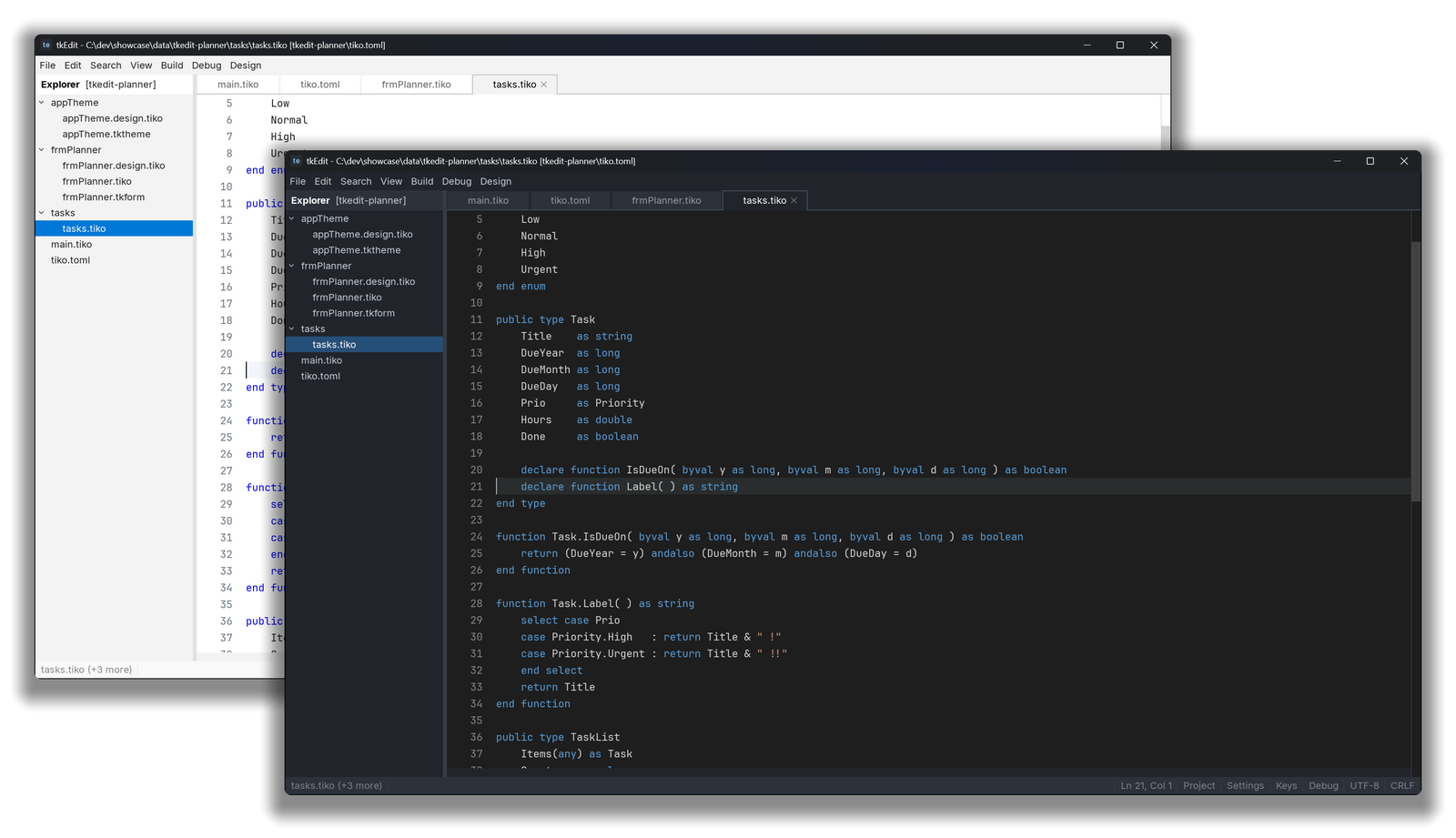
tkEdit
Multi-buffer editing with tiko-aware highlighting, a project explorer, light and dark themes, and build-and-run on F5.
Get started →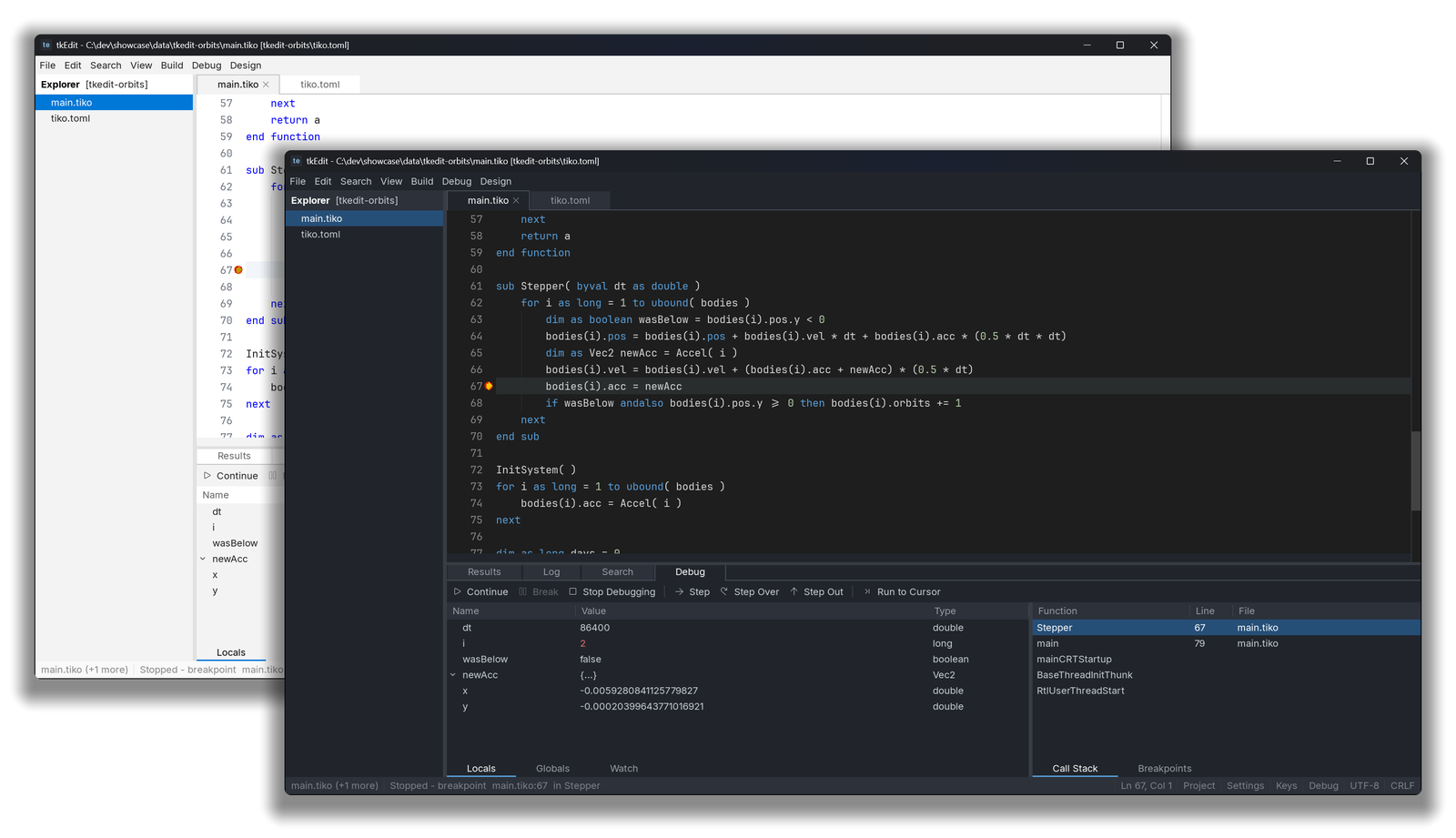
Source-level debugging
Breakpoints, stepping, run to cursor, and locals, globals and watches as trees. Hover over a name to see its value. It runs on lldb-dap.
Debugging in tkEdit →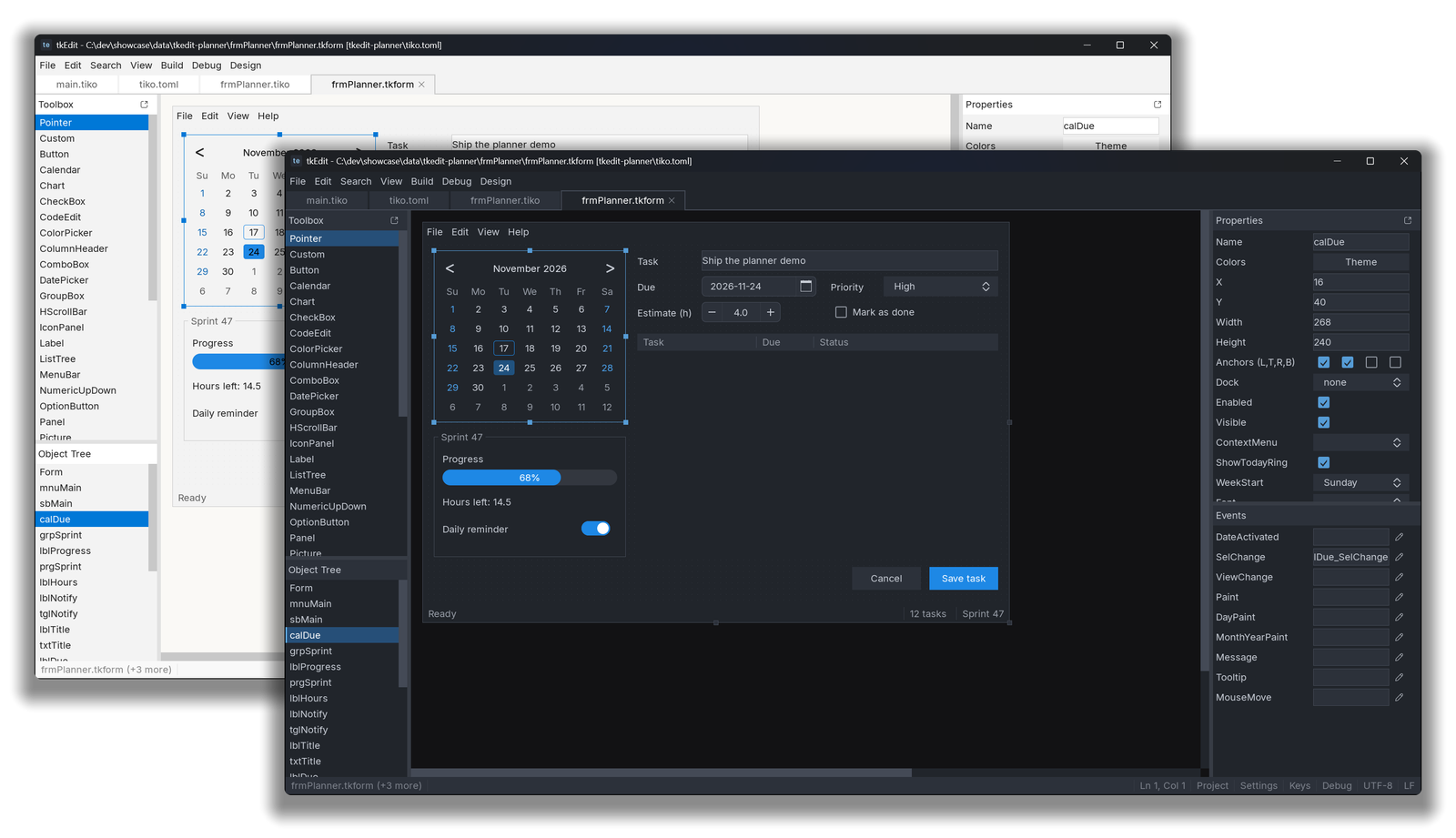
Form Designer
Draw a window from real tkControls, double-click a control to write its handler, and bind controls to your data. The output is ordinary tiko source.
Form Designer guide →Over 60 controls for native apps. They look the same on every system.
A GUI toolkit written in tiko, with a data grid, charts, a code editor, printing and reports. It ships with the toolchain: #import a control and build.
- Windows, Linux and macOS build from one source, with no changes. Every control draws itself on SDL3. Android too, experimentally.
- Themeable: light, dark, or your own palette. The fonts are bundled.
- Data-binding aware Bind:
LoadFromfills a form from a record andSaveTovalidates it and writes it back. Grids and lists fill from an array or an SQLite query. - MPL 2.0: you can use the controls in closed-source software.
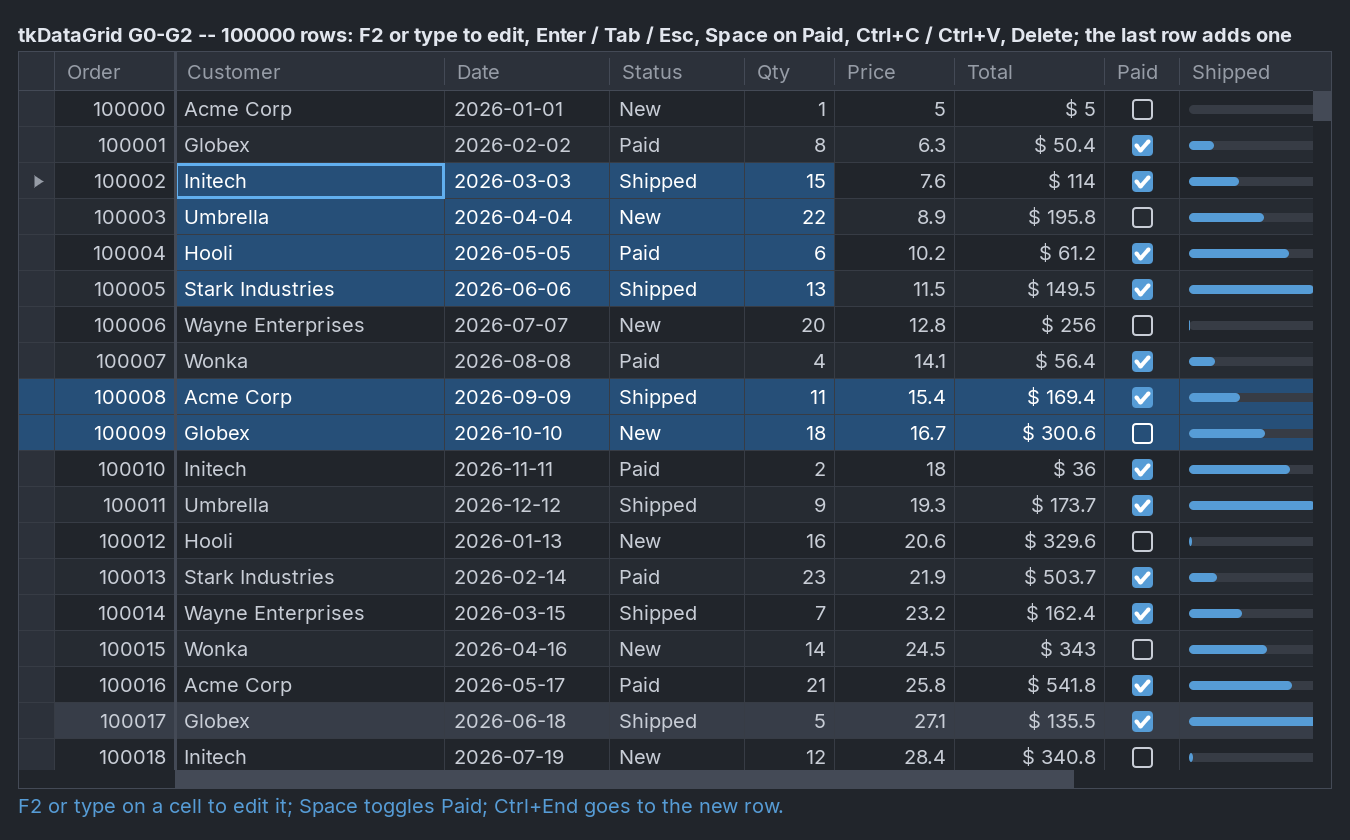 tkDataGrid · 100,000 rows, edited in place
The same source, on a phone
A tkControls program is also an Android app. tiko compiles it, links it and signs it as an APK, with no Java, Kotlin or Gradle project to keep.
- One command:
tiko -target android-arm64 -app hello.tikowriteshello.apk, ready foradb install.-appbundlemakes an App Bundle for Google Play. - Made for touch: taps, swipes with fling, long press, the screen keyboard per field, the safe area and the BACK button, in every control.
- Built on Windows with Android Studio's SDK and NDK, for Android 10 or newer: phones (arm64) and the emulator (x86-64).
tiko -target android-x86_64 -app hello.tiko
adb install -r hello.apk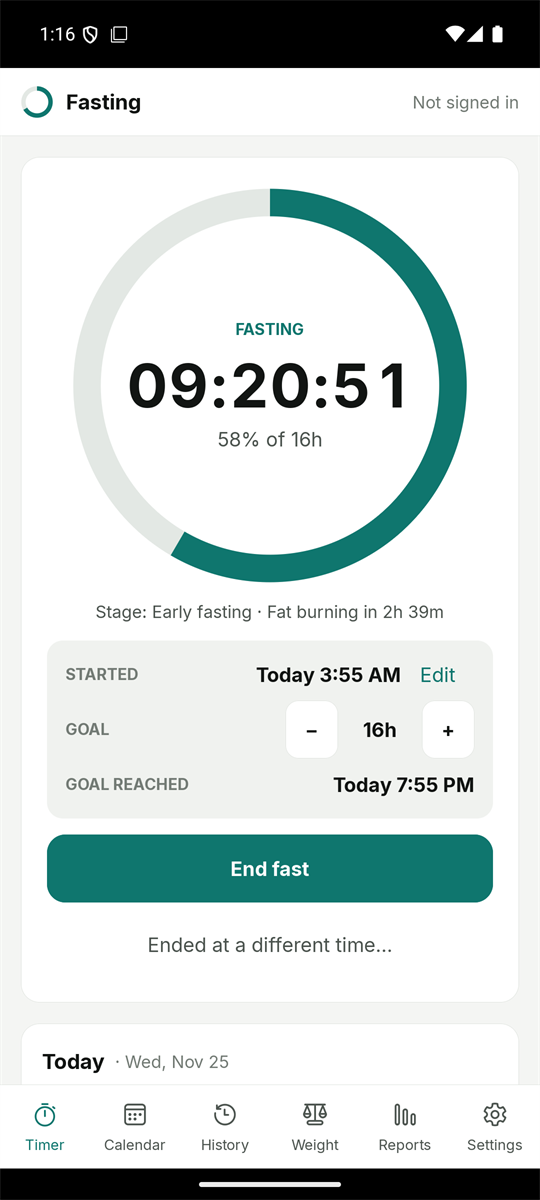
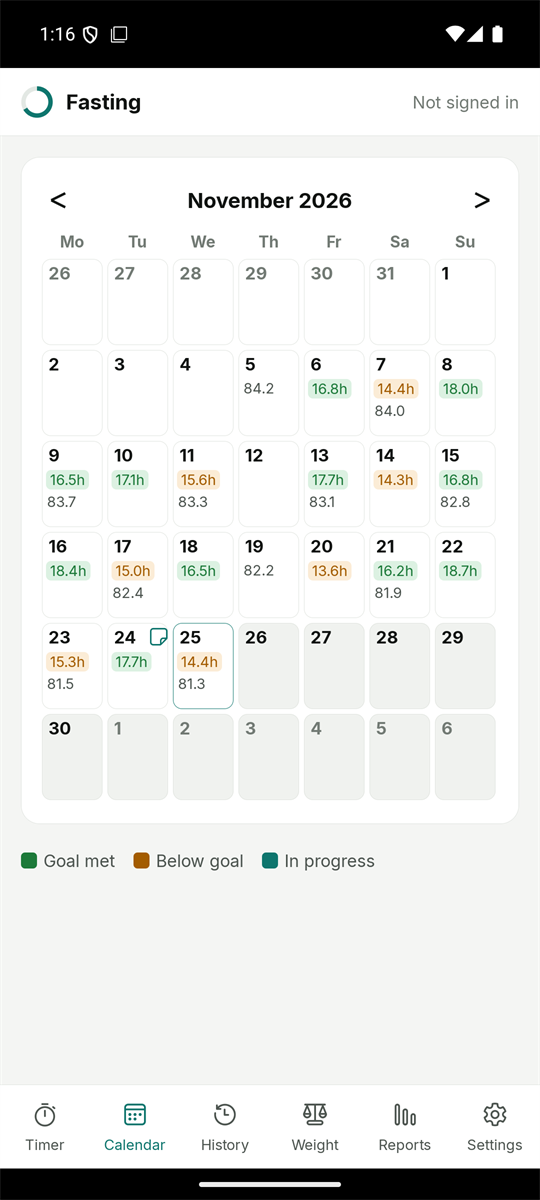
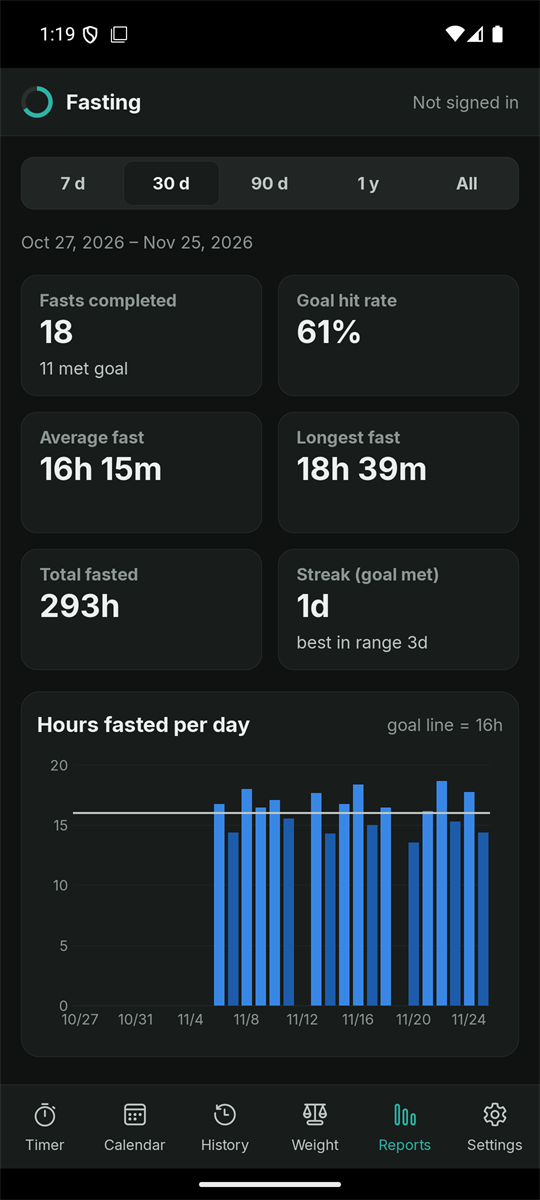
Fasting, written in tiko with tkControls, on the Android emulator

tiko is young, and growing fast
It's pre-1.0: try it, break it, tell us on GitHub. Coming from FreeBASIC? tiko compiles FreeBASIC code, and .bas/.bi files mix freely with .tiko/.ti.